
First-party benchmark · collected 2026-09-17
Website Redesign Proposal Clarity Benchmark 2026
A 16-page convenience sample of public website-redesign provider/editorial pages shows that process, timeline and pricing mechanics are commonly disclosed, while ownership/handoff and revision/change-control are less consistently explicit.
Process / delivery stages
15/16
94% of this sample
Timeline / schedule
14/16
88% of this sample
Pricing / budget mechanics
13/16
81% of this sample
Post-launch support
12/16
75% of this sample
Ownership / handoff
8/16
50% of this sample
Revision / change control
8/16
50% of this sample
What the sample says
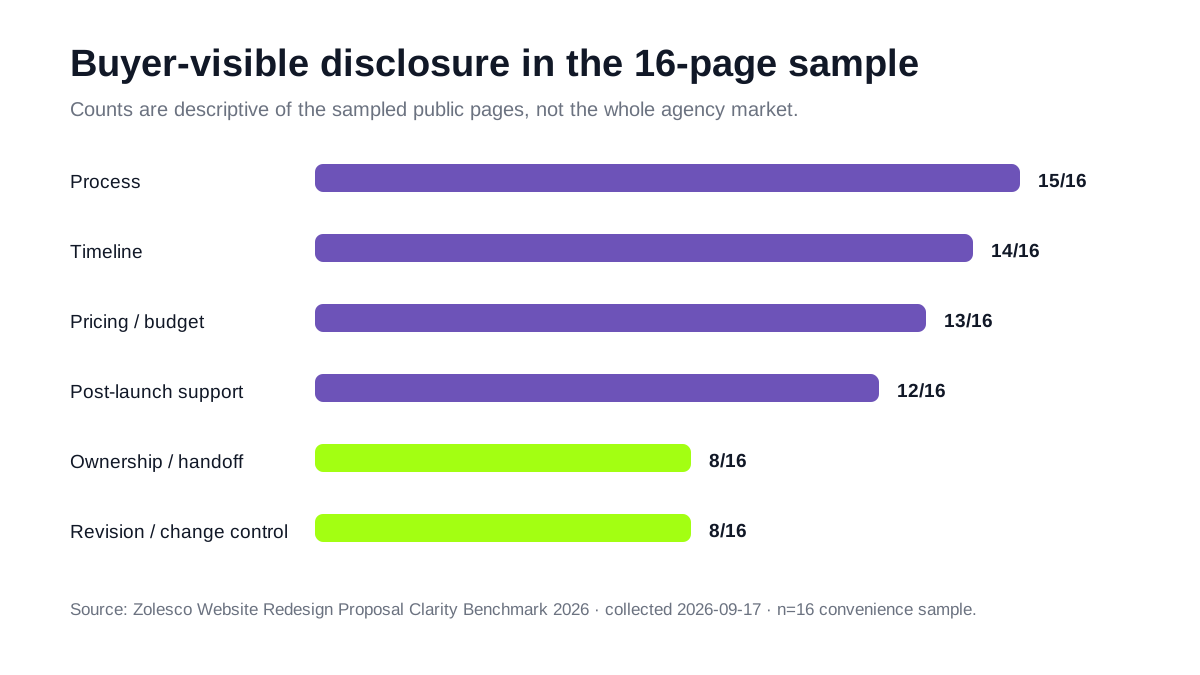
Process (15/16), timeline (14/16) and pricing/budget mechanics (13/16) were the most frequently explicit fields. Post-launch support appeared on 12/16 pages. Ownership/handoff and revision/change-control were each explicit on 8/16 pages.
This is a descriptive finding about the sampled public pages—not evidence that providers with more disclosed fields deliver better work. The buyer-side implication is narrower: ownership and change-control questions are worth making explicit when comparing proposals because public pre-sale pages disclose them less consistently in this sample.
Sample definition
Sixteen English-language public pages discovered during Zolesco Phase-24/33 web research and selected because they address website redesign services, cost, timing, procurement, migration or handoff. The sample is a search-discovered convenience sample, not a probability sample of the agency market.
Methodology
- Freeze the sample before coding and retain one public source URL per observation.
- Code only buyer-visible disclosure on the sampled page; do not infer undisclosed contract terms from an agency brand, other page or private proposal.
- Treat a field as disclosed when the page gives a meaningful buyer-facing cue, not merely a keyword mention.
- Use binary coding for six fields: process, pricing/budget mechanics, timeline, ownership/handoff, revision/change control and post-launch support.
- Preserve row-level notes so ambiguous classifications can be challenged or recoded.
- Report simple counts and percentages only; do not rank providers or infer market-wide prevalence from this convenience sample.
Limitations
- The 16-page sample is small, English-language and search-discovered; it is not statistically representative of all agencies, countries or price bands.
- Public pages can change after the collection date. The downloadable dataset records the observation date, not a permanent truth about each provider.
- Binary coding compresses nuance: a brief mention and a detailed disclosure both count as present if they meet the coding rule.
- The study measures public proposal-clarity cues, not service quality, client satisfaction, delivery competence, ranking strength or commercial performance.
Exclusions
- Directories/marketplaces without a single provider disclosure model were excluded from the coded sample.
- Official standards/search documentation were used for context in other phases but are not provider observations here.
- Private proposals, sales calls, gated documents and information unavailable on the sampled public page were not inferred.
- Pages that were not clearly about website redesign delivery, procurement, cost, migration or handoff were outside this pilot.
Analysis logic
- For each field, sum TRUE values across the 16 observations.
- Divide each count by 16 to show a descriptive sample percentage.
- Use the lower-disclosure fields only as buyer-education opportunities; never label a sampled provider better or worse from this scorecard.
- Any future comparison across years must preserve or explicitly version the sample definition and coding rules.
Update frequency: Re-run annually or when a materially different research question/sample design is approved.
Observation register
Yes/No indicates whether the sampled public page made that field meaningfully visible under the published coding rule. Source links are preserved for reproducibility; provider order is not a ranking.
| Provider / page | Process | Price/budget | Timeline | Ownership/handoff | Revision/change | Post-launch |
|---|---|---|---|---|---|---|
| WebRankoWebsite Redesign Agency UK | Yes | Yes | Yes | Yes | No | Yes |
| RATH InfotechWebsite Redesign Services in Dubai | Yes | Yes | Yes | Yes | No | Yes |
| Launch Day AdvisorsWhat a Website Redesign Actually Costs in 2026 | Yes | Yes | Yes | No | Yes | No |
| CommsHow Much Does a Website Redesign Cost in 2026? | Yes | Yes | Yes | No | Yes | Yes |
| theCSS AgencyWebsite Redesign Cost Pricing Guide 2026 | Yes | Yes | Yes | No | Yes | Yes |
| SiteimproveEnterprise Website Redesign Readiness Assessment | Yes | No | No | No | No | No |
| LOW/CODEWebsite Redesign Timeline | Yes | Yes | Yes | No | Yes | Yes |
| AlkaliWebsite redesign timeline: how long it takes and what makes it late | Yes | Yes | Yes | No | Yes | Yes |
| Inoviq LabHow to Preserve Google Traffic During a Website Redesign | Yes | No | Yes | No | No | Yes |
| AMS DigitalWebsite redesign SEO: how to migrate without losing visibility | Yes | No | Yes | No | No | Yes |
| LatteWebsite Redesign RFP Template | Yes | Yes | Yes | Yes | Yes | Yes |
| QuovoWebsite Redesign RFP: What to Include Before Contacting Agencies | Yes | Yes | Yes | Yes | Yes | Yes |
| CubertoWebsite Redesign RFP: What Agencies Actually Need From You | Yes | Yes | Yes | Yes | Yes | Yes |
| Smartlance DesignsWebsite Redesign Checklist | Yes | Yes | Yes | Yes | No | No |
| Handover AgencyWebsite Handover Checklist | Yes | Yes | No | Yes | No | Yes |
| Webo CreatorsWebsite Redesign Cost in Pakistan (2026 Guide) | No | Yes | Yes | Yes | No | No |
How to use this benchmark
Use it as a procurement-question prompt, not a vendor score. Ask every shortlisted provider the same ownership, revision, acceptance and post-launch questions and evaluate the written proposal against your project constraints.